While I was working on the Goya in the last post, the folks in charge of NGA's Art Around the Corner program came by to ask if I might be interested in doing some sessions with the students in the January session. I was thrilled to accept, because this program is an opportunity to make a real difference in some kids' lives through art. The NGA partners with DC Public Schools to bring 4th and 5th graders into the Gallery several times a year, not just to look at the art, but to participate in artmaking as they learn to see the world through artists' eyes. It is one of the most gratifying experiences I have had as a painter. To learn more about this program and to see it in action, here's a video made in 2011 which shows how it happens: https://www.nga.gov/audio-video/video/art-around-the-corner.html
Showing posts with label portrait. Show all posts
20220406
Art Around the Corner
The project this time was portraiture, and the organizers chose this fantastic Van Gogh portrait as the point of departure. My role was to discuss the artist with the kids, give them a chance to talk about what they saw in the painting, and to demonstrate for them how a copyist works to re-create a painting in real time. I worked with several groups over the course of two days, and in addition to Vincent, we talked about other portraitists both within the NGA and without. I discussed Amy Sherald's incredible portrait of Michelle Obama which hangs at the Smithsonian NPG. Many of them had seen it, and all of them lit up when shown an image of that painting. This session happened during the aftermath of George Floyd's murder. One of Amy Sherald's driving principles is that skin color is what we make of it. Her portraits have skin tones greyed out, making the point that we are all the same color, just different shades of light and dark.
As for Vincent, he's green--and the kids took that idea and ran with it. I wish I had images of their work, which truly turned out far superior to my own. Below is my setup for the first session and near completion on the second day.
This was February 2020. I was already seeing more international visitors wearing masks, and was just starting to wonder how concerned I should be about Covid, since as a Copyist, I was constantly engaged with people in the gallery, having animated discussions about my work, the art and the artists--my favorite part of the job. Then a month later, official lockdown began, and everything closed down. Even now I don't know if this program was reinstated after things opened up again. My husband and I left DC after a full year of hard isolation, just as soon as we were vaccinated.
I hope that this won't turn out to have been the last time I set foot in the National Gallery, or the last time I paint there. It is the last time for the foreseeable future. Here's a photo from happier times.
20220124
Goya, Phillips, Cezanne
This is Goya's portrait of Bartolome Sureda y Miserol, from 1803-4. My version is near completion here, I did change the aspect ratio just a bit. The subject was a friend of Goya's, and was quite an ambitious and interesting person. This was the penultimate painting I did as a copyist, finished December 2019. While working on this, I was asked to do a commission of a painting attributed to John Phillips, from a low-resolution photo for reference (the best available from the gallery in the UK). The painting (on linen panel) turned out well, and the clients became good friends. Completed just before lockdown began in 2020.
There was one more NGA painting that I started in January 2020, Cezanne's "Houses in Provence: Riaux Valley near L'Estaque". I had finished the underpainting in raw sienna, when a visitor to the NGA fell in love with it just as it was, so I happily sold it to her since I knew I needed a break.
20191025
Post Emily
Life has been quite a ride this past two months, including moving (twice) and having an up-close-and-personal encounter with an unwell wild bat which necessitated a series of post-exposure rabies vaccines. But what do we do when life happens? We keep painting.
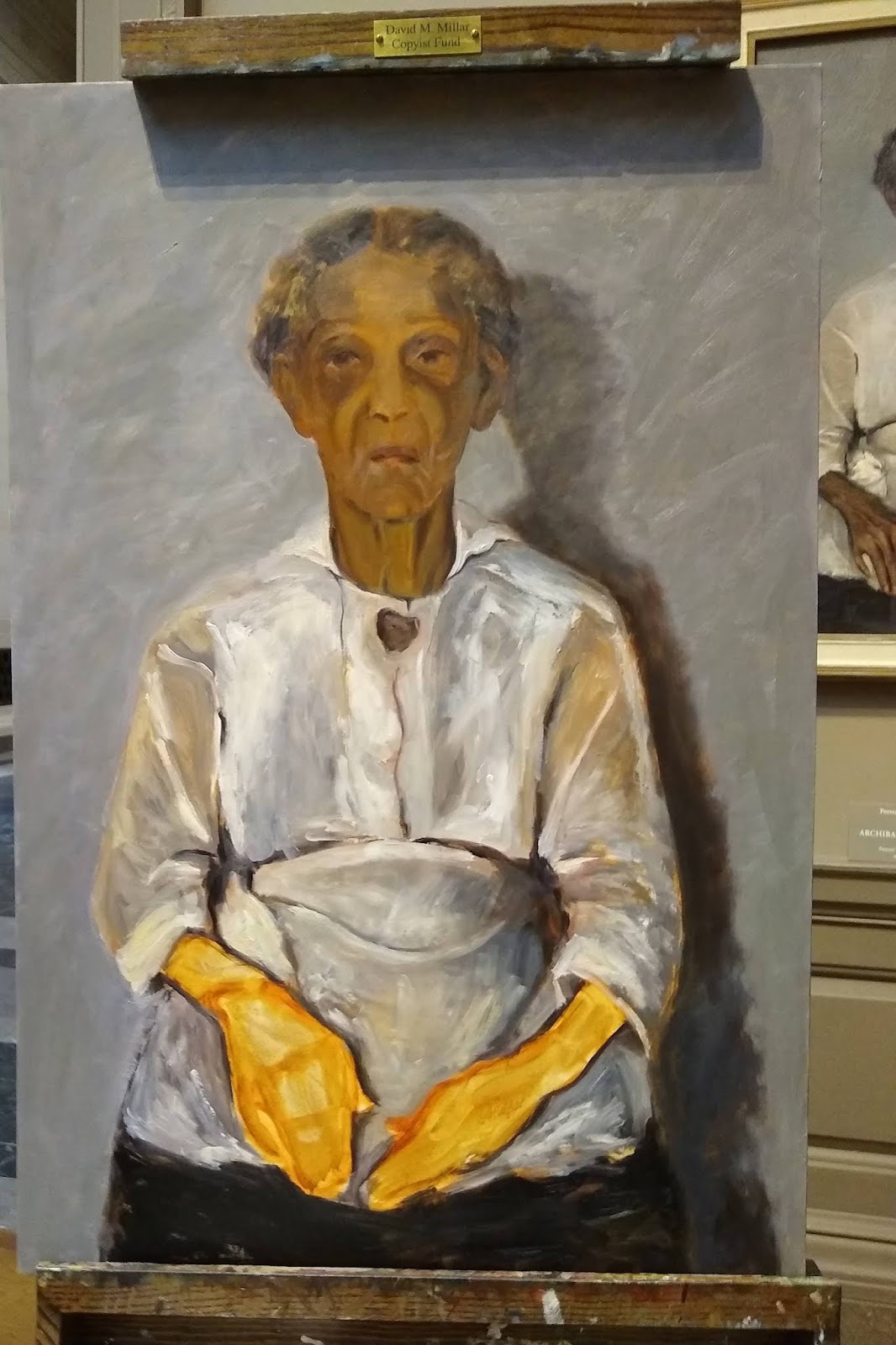
I finished working from Portrait of My Grandmother two weeks ago, and there may be some tweaks that I'll add in the home studio but all in all, it turned out very well. This is 36" x 24", and I will post some progress shots below.
Can you tell that my favorite element in this painting is her hands? They almost painted themselves. Here is a look back at from the start.
Motley's painting is loaded with texture. He painted it on a rough canvas laundry bag, as mentioned in the previous post, and he worked in thick layers of paint over that rough support. There are places where his brush visibly skipped over wrinkles that were already forming, before the painting was even done. To suggest that texture on my comparatively smooth canvas, I used thick random brushstrokes and layers. In the first session, I tried to get the drawing and composition more or less there, and laid on a lot of paint. From there it was mainly corrections and refinement.
I don't know if Motley used an underpainting, we don't know much about his process especially for these early paintings that weren't his mature style. I used burnt sienna for the wash and drawing, and then fought it the rest of the way to get her coloring accurate.
I don't normally paint in a "serial" fashion, meaning I normally work up the whole surface of the canvas as a unit, not one area and then another area. Motley's painting shows dark outlines around the hands, as if he drew their placement and then painted them separately later. This painting was almost certainly done from life, and an 80-year-old woman would not be able to hold a pose for a very long time...so it would make sense for him to work the more challenging sections (face and hands) to completion one at a time. That was how I painted her hands. Established the shape and then in one session, painted them in.
Her face is a portrait of character, dignity, life history. It was by far the most challenging part of my painting. I kept putting emotions there which were mine, not hers. She's not sad in Motley's painting, but I kept finding sadness in mine. Portrait painters connect with subjects and ideally, paint the essence of the sitter. That's where being a copyist is different. Motley painted Emily with his own lifetime knowledge of her. In the end, his is a painting of Emily. Mine will always be a painting of a painting. Over the ten weeks that I worked on this, I met a lot of sincerely interested visitors and I got to share Emily's story with countless people. I wanted to do her justice, and hope that I did.
20190821
Emily
The Kenyon Cox piece is finished, I'll update the image in the previous post. The next project will be this glorious painting by Archibald Motley Jr., a work which was just acquired by the National Gallery from the artist's family late last year:
The lady whose portrait this is, Emily Motley, is the artist's grandmother. She was born into slavery in 1842, and freed when she was about 20. Married a Native American who had also been a slave, and they raised a beautiful, successful family. Archibald Motley Jr. graduated from the Art Institute in Chicago in 1918 and struggled to succeed as a painter, so he worked as a porter on the Wolverine, a train from Chicago to Detroit. His father was also a porter on that train, one of the best jobs available to African Americans at that time. Motley could not afford to buy quality art supplies, so he used a canvas laundry bag from the train as a support for this painting. This explains the extraordinary texture, which I'll talk more about as I work. He struggled for a long time to finally become successful as a modernist, totally different style, but his portrait and the other one of his grandmother are his finest work IMO and they were his favorite paintings. She was about 80 when this was painted in 1922.
I highly recommend the supporting material on the NGA website, with videos that really expand on one's understanding of the importance of this work. Curator Nancy Anderson's talk is absolutely wonderful, providing essential context and enlightenment about this work.
The other painting of Emily is the richly symbolic "Mending Socks", 1924, which is in the collection of the Ackland Museum in Chapel Hill NC. I had the opportunity last month to view that work and the curatorial file, which is filled with articles, interviews and documentation relating to both these works. I'll have more to say as my work progresses.
The lady whose portrait this is, Emily Motley, is the artist's grandmother. She was born into slavery in 1842, and freed when she was about 20. Married a Native American who had also been a slave, and they raised a beautiful, successful family. Archibald Motley Jr. graduated from the Art Institute in Chicago in 1918 and struggled to succeed as a painter, so he worked as a porter on the Wolverine, a train from Chicago to Detroit. His father was also a porter on that train, one of the best jobs available to African Americans at that time. Motley could not afford to buy quality art supplies, so he used a canvas laundry bag from the train as a support for this painting. This explains the extraordinary texture, which I'll talk more about as I work. He struggled for a long time to finally become successful as a modernist, totally different style, but his portrait and the other one of his grandmother are his finest work IMO and they were his favorite paintings. She was about 80 when this was painted in 1922.
I highly recommend the supporting material on the NGA website, with videos that really expand on one's understanding of the importance of this work. Curator Nancy Anderson's talk is absolutely wonderful, providing essential context and enlightenment about this work.
The other painting of Emily is the richly symbolic "Mending Socks", 1924, which is in the collection of the Ackland Museum in Chapel Hill NC. I had the opportunity last month to view that work and the curatorial file, which is filled with articles, interviews and documentation relating to both these works. I'll have more to say as my work progresses.
20180526
Rembrandt in Progress
This is a lovely Rembrandt portrait at the National Gallery, and a copy was commissioned by the good people who bought my painting of the Lievens Bearded Man.
We do not know the identity of the sitter, it hangs side-by-side with this portrait, and it seems that this pair of portraits might be husband and wife. Rembrandt made many portraits of wealthy Dutch people who are not known to us now. This pair of portraits has a very interesting provenance involving the Yusupov family, surviving both the Napoleonic invasion of Russia and the Bolshevik revolution. The paintings were taken off their stretchers, rolled up and smuggled out of Yalta aboard a British ship. They are now part of the National Gallery's permanent collection.
I'm three sessions into the Rembrandt, and the work is coming together. It's a difficult painting to work from even in person, because the dark parts are very dark. It's not due to old varnish, this painting had a complete conservation in 2007; but the contours in the drapery have darkened to near-imperceptibility. My guess is that Rembrandt used lead white as a lightener to describe the folds, and that has now darkened and become nearly as black as the areas around it. The high-res image on the NGA website is actually much better, because it was taken under very bright light which reveals more of the contrast than can be seen in person. Another very interesting fact about this painting is that it was transferred from one canvas to another (not relined, actually transferred) by a Russian conservationist during the 1800's. It wouldn't seem even possible, and is not a method that modern conservation would employ (since all modern conservation measures MUST be reversible), but it was commonly done then. More information can be found online about the process to transfer a painting from one support (canvas or wood) to another, among the riskiest procedures ever used. Here's a link to the technical notes about this specific painting. The newer notes no longer mention this procedure, but they did when I painted this.
Work in progress, 24" X 20".
We do not know the identity of the sitter, it hangs side-by-side with this portrait, and it seems that this pair of portraits might be husband and wife. Rembrandt made many portraits of wealthy Dutch people who are not known to us now. This pair of portraits has a very interesting provenance involving the Yusupov family, surviving both the Napoleonic invasion of Russia and the Bolshevik revolution. The paintings were taken off their stretchers, rolled up and smuggled out of Yalta aboard a British ship. They are now part of the National Gallery's permanent collection.
I'm three sessions into the Rembrandt, and the work is coming together. It's a difficult painting to work from even in person, because the dark parts are very dark. It's not due to old varnish, this painting had a complete conservation in 2007; but the contours in the drapery have darkened to near-imperceptibility. My guess is that Rembrandt used lead white as a lightener to describe the folds, and that has now darkened and become nearly as black as the areas around it. The high-res image on the NGA website is actually much better, because it was taken under very bright light which reveals more of the contrast than can be seen in person. Another very interesting fact about this painting is that it was transferred from one canvas to another (not relined, actually transferred) by a Russian conservationist during the 1800's. It wouldn't seem even possible, and is not a method that modern conservation would employ (since all modern conservation measures MUST be reversible), but it was commonly done then. More information can be found online about the process to transfer a painting from one support (canvas or wood) to another, among the riskiest procedures ever used. Here's a link to the technical notes about this specific painting. The newer notes no longer mention this procedure, but they did when I painted this.
Work in progress, 24" X 20".
20180211
Pope Innocent X
I'm wrapping up my latest National Gallery Copyist painting, and this one has an interesting background. I'll also talk more about the process and numerous benefits of copying, at the end of this post.
Here is the almost-finished painting, in front of the original:
We must use a larger or smaller support than the original. Since there are other references in a larger format (see below), I chose to go bigger (24 x 18), and the proportions are a bit different.
The original and the details of it can be seen on the NGA website, here. This painting was bought by Andrew W. Mellon in 1930 as an original Velazquez, but scholars have since established it as "Circle of Velazquez". Velazquez painted the full size portrait of Pope Innocent X in Rome, here is an image of that:
Here is the almost-finished painting, in front of the original:
We must use a larger or smaller support than the original. Since there are other references in a larger format (see below), I chose to go bigger (24 x 18), and the proportions are a bit different.
The original and the details of it can be seen on the NGA website, here. This painting was bought by Andrew W. Mellon in 1930 as an original Velazquez, but scholars have since established it as "Circle of Velazquez". Velazquez painted the full size portrait of Pope Innocent X in Rome, here is an image of that:
This portrait is still in Rome. The Pope, upon seeing it, said "Troppo vero, troppo vero!" Too true! (This is the work that inspired Francis Bacon's Screaming Pope paintings in the 1950's)
Then, Velazquez painted what is known as an "autograph replica"--a copy of his original, for himself. That painting now resides in London, and here is an image of it:
Both of these are known to be by the hand of Velazquez, so the work at the NGA was assumed to be another replica or study also painted by Velazquez.
Time and modern technology have made better assessment possible...there is an unrelated painting underneath it. In addition, the expression and other elements have become a little bit exaggerated. On the ear, there is a visible series of dots--revealing a process that was frequently used to transfer an image. This was most likely painted by a workshop assistant or student, on a discarded canvas. We can't possibly know for sure, but the evidence seems compelling.
In making my copy, I decided to undo some of the distortion of the eyes and brow, and make mine closer to the original or the autograph replica--both of which have a much more believable expression. I referred to high-resolution images of those works, and relied on the paint and brushwork of the painting in front of me.
My process, as in the past, is to paint from what's in front of me. No tracing or mechanical transfer of the image, because duplication is not my goal...learning is. While I'm grappling with visualizing the original, my errors are woven in and my own voice shows through. This is the greatest gift of copying, I think. It's a lesson from a master, but ultimately it comes through me and produces something original, just as this "Circle of Velazquez" rendition did for whomever painted it.
Copying is a standard part of an artist's training in school and beyond. We see differently and absorb things in a unique way when we copy--written, drawn or painted. Linda Barry likens it to singing along with a song you love, because it takes you somewhere. And yet, the voice is yours.
My result, minus final touches:
20171215
Portrait project 4
Here are two portraits of the same sitter, and a story to go along with them. I'll start with the one that I feel best captures who he is.
He's confident, happy, has a megawatt smile. He's also a busy professional with very little free time. He's a football fan (Go Redskins!), so when he came by for a sitting, he asked if he could listen to the game on headphones while I sketched him. I always want people to be comfortable and at ease while I'm working, so I said sure! Unfortunately, the team missed a field goal and fell behind, so the expression I got was actually more like this:
Not that there's anything wrong with that, I was very taken with the drama that unfolded on his face, but I struggled terribly to complete an accurate likeness (later repainted it 8 times, and then abandoned)--because this really isn't who he is. Fortunately, I had time to chat with him enough to get to know him, and took some reference photos--one of which enabled me to get the likeness in the top image here.
Yesterday I happened to talk to another portrait painter while painting at the National Gallery, and she mentioned how difficult it is to get people to come for a live sitting at all any more; they would rather just submit photos. People are busy, which is understandable, but a portrait painted from a photo without the benefit of "face time" with a sitter will never capture the same energy and character. There's something sublime that happens between the subject and the painter, that makes it possible to portray the sitter's best self: a blend of how they see themselves, how the painter sees them, and the essence of their personality. I am glad I had enough time with this guy to get to know him a little, because that's what saved me.
20171118
Portrait Project 2 & 3
Here are the second and third in the series of portraits. In these difficult times, portrait painting makes me feel more connected than anything else to my fellow humans.
Haley and John, 12 x 12 oil on canvas.
20171004
the Portrait Project
Since I've just moved across six time zones to a new apartment community, I thought about this project as a way to meet my neighbors while sharpening my portrait skills. I posted the idea on the community web page, and got some interest. This is the first portrait of hopefully many. He's a retired Coast Guard veteran and cancer survivor. He moved here about the same time we did.
12 x 12 square, stretched canvas. I've also begun a new copy at the National Gallery, a Van Gogh. We'll see what happens with that!
Subscribe to:
Posts (Atom)