Showing posts with label watercolor. Show all posts

20170913

Drawing as a Journal

The last blog post was about the fairly rigourous practice of natural history illustration. Nature journaling, on the other hand, can be as personal as a diary. The main reason to do it is to enhance your memory of your experience and to help you remember what you saw and questions to ask later, to learn even more. Graphite, colored pencils, and watercolor are all immensely portable and time-tested tools for recording the moment.


Nature journal pages from a couple hours in a park in Austin TX, watching Great-tailed Grackles and other birds. A nature journal is a personal record, not scientific or convening to standards. It's a way to remember what you saw and to ask questions to be answered later. It is not at all about creating a work of art. 
The best reason to do it is to remember that experience in a completely different way than simply taking photos. I'll never forget these birds, their sounds, their actions, even the weather and the feel of the breeze that day. And I learned a lot about them later by finding answers to questions I noted in the moment.

A journal can include sketches of anything. The scene outside your window each day, the clouds in the sky, anything you would like to remember having experienced or would like to research more later. As part of our recent move to Maryland, I've been finding images of fishes that are common here and sketching them for #SundayFishSketch on Twitter. Here are a couple of those, a Bluefish and a Longnose Gar.


For more about nature journaling, I recommend John Muir Laws, his books and videos. Among the many many books on the subject, his approach worked best for me. Audubon.org has an excerpted demo on How to Draw a Lazuli Bunting, and also here's an article on How to Go from Watching Birds to Drawing Them. As it says in the article, sketching doesn't just make you a better artist, it makes you a better observer of the natural world. And you'll make unforgettable memories, whether you make "art" or not.


20150923

monotype, cont.

 There are myriad variables with each image--what medium to paint in, what paper to use... even differing degrees of dampness in that paper will determine how sharp the resolution is and how much color transfers.  This is on kitakata paper.  The background was printed first, the bird transferred from a second plate, then some details added with an ink brush.

This is a simple study of the outside surface of a pineapple, done in gouache and printed on drawing paper.  Monotype is known as the "painterly print."  Each impression is unique because most all the paint comes off with the first print, so they can't be duplicate-printed.  The main advantage is that the process allows the introduction of textures which can't be made any other way.  

Spoon and shadow, Neocolor II water-soluble crayon on frosted mylar, printed on Rives Lightweight printmaking paper.  Heavyweight papers are great if you have a press.  Working by hand, lighter-weight papers respond better to less pressure. 

20150920

monotypes


I've been playing with hand-pressed monotypes, a process I've loved since art school.  It really changes things up.  I don't have a press, so these are pulled by hand.  The above plate was painted in watercolor, three layers, left to dry, then printed onto soaked and blotted Japanese kitakata paper. Image size 7" x 5"


This is a drawing in black Oilbar on the plate, printed onto toned drawing paper (which didn't like the punishment).  This will become a chine colle'.  Approx 4" X 6"

Mourning Doves.  On the right, the image was drawn subtractively using black Oilbar.  That image was the source for the plate on the right, painted in black gouache.  Both are on Johannot, and reveal interesting differences.  Textures and effects are possible in monotype that can't be achieved with any direct method. And pulling a print is like opening a present:  you never know what you'll get. 

20150916

Day at the Beach


 Pyramid Rock, on the Marine Corps Base Hawaii at Kane'ohe. The storm surge was just starting, from the latest of many hurricanes this year.  Water-soluble graphite.


20150914

Leaving Las Vegas


 Hard Rock Hotel seen from my room, with a huge empty lot and remains of a foundation and parking lot in between.  Looking a little post-apocalyptic.

Mountains to the east.

This is a small sampling of what you will see at Valley of Fire State Park, about an hour northeast of Las Vegas.  A range of impossibly red rock formations have emerged from the desert thanks to eons of erosion.  The color is astonishing, and the rock is carved by the wind and blowing sand into fantastical shapes.  Nature creating her own version of a Gaudy Hellscape.

20150912

More Vegas


One writer documenting DefCon referred to Las Vegas as a "gaudy hellscape", which I think is the most perfect description ever and not in a bad way.  The artificial colors everywhere heighten awareness of all the natural colors too (and the desert heat can certainly conjure up an inferno).  This fairly ordinary scene behind the Tuscany Hotel is enlivened by the amazing colors of the buildings, and by my near-delirium due to the 110-degree temperatures.

Bally's Hotel, site of DefCon.

One of the (fairly normal-colored) hotels where we stayed.

20150910

Vegas

A ten-day trip to Las Vegas last month produced some new little watercolor sketches, plein air.  Hotter than blazes, the paint dried almost before it hit the paper.  The colors are amazing in the thin desert air.

 Industrial park, south Las Vegas.  Red Rock Canyon in the distance.

Mandalay and Luxor hotel/casinos.  

 
Palms with bright red seed pods.

Looking down from the hotel room.

20150906

Aliens


Hawaii is home to many species of birds, but not all of them started out here.  Residents now, but at one point, alien invaders.   All below are watercolor, all painted from life.


 Red-Vented Bulbul.  These, along with Mynahs, are the most plentiful birds on the island.  Not so welcome.  Considered invasive, injurious to native species and plants.  Native to Asia, illegally introduced on Oahu in the 1950's.  They are *everywhere*.  The other islands either don't have them, or only a few (so far).


The Common Myna(h), also an Asian import, is so ubiquitous that many people don't know they didn't originate here.  Believed to pair for life, they are extremely prolific and displace other birds, even robbing nests.  Mynahs are related to starlings, and their huge gatherings generate quite a lot of noise.  They are funny and endearing to watch, though, so it's hard not to love them.  We don't have crows here, and I miss them.


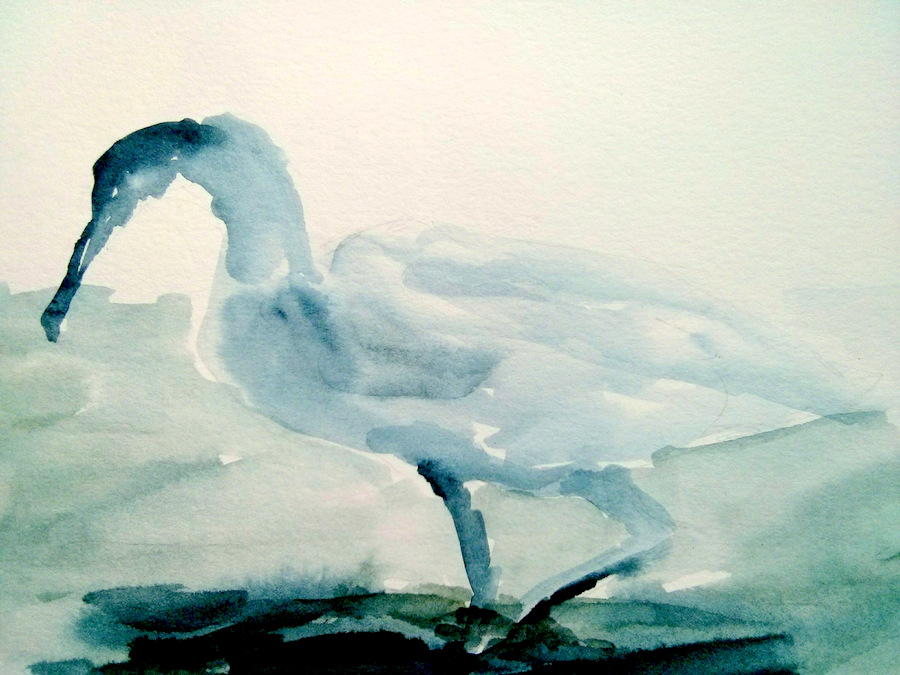
NOT an alien.  The Pacific Golden Plover, also quite numerous, is a welcome migratory species.  Breeding season is spent in northern Alaska, then they winter in Asia, Hawaii, even Southern California. They are seen everywhere here in the fall and winter, even on grassy areas in very urban environments.  This one was fast-moving, the painting was done quickly with no drawing.

20150830

sketching Hawaii


The Ko'olau mountains usually are engulfed in clouds, which makes the sunrise beautiful.
Below, the hills much closer to our apartment are remnants of a small volcanic crater (unlike the enormous volcano that resulted in the Ko'olaus).


20150827

more from the sketchbook


In January, we sold our boat after living aboard for a year, and in April, we moved to Hawaii.  In the months before the move, I biked around to familiar places in San Diego and did little sketches.  Sort of saying goodbye. 


This is the first one I did after we got to Hawaii.  We're definitely not in Kansas any more!


20150826

pages from the sketchbook


I made a pocket-size sketchbook using Hahnemuhle Ingres drawing paper, which has become a favorite support for watercolor as well.  Some of those works in the last post are also on that paper.  This tiny sketchbook went with me everywhere while we were preparing to move away from San Diego, and I did a bunch of these little studies, a couple of them out on the Point not far from Cabrillo.  I'll post a few more tomorrow.

20150824

East County watercolors


These are small watercolors I did east of San Diego, from a few months back.  Top one is 6 X 9, lower one is 4 X 7. I'll post a few more soon, and talk about where I am and what I'm doing now.  

20150125

East County sketches


All about 5 x 7", plein air sketches

20141023

San Diego River wetland. 5 x 7".

Dowitcher

Little Blue Heron

Long Billed Curlew

20140919

Sunset, Waikiki. Farewell to Hawaii for now, but not for long.

20140917

Pyramid Rock, beach at MCBH, Kaneohe Bay. It was almost too hot to paint that day and no shade around, so this was done very quickly indeed.

Studies of the lava mountains above Waikiki that form the Honolulu watershed.

Different time of day and rare cloud-free sun.