This little finch is a Chestnut Munia, originally from the Philippines. They are not plentiful here, but a welcome addition. I've only seen one since we moved here. Their beaks really are blue.
Showing posts with label monotype. Show all posts
20150930
Hawaiian Birds in monotype
This little finch is a Chestnut Munia, originally from the Philippines. They are not plentiful here, but a welcome addition. I've only seen one since we moved here. Their beaks really are blue.
20150928
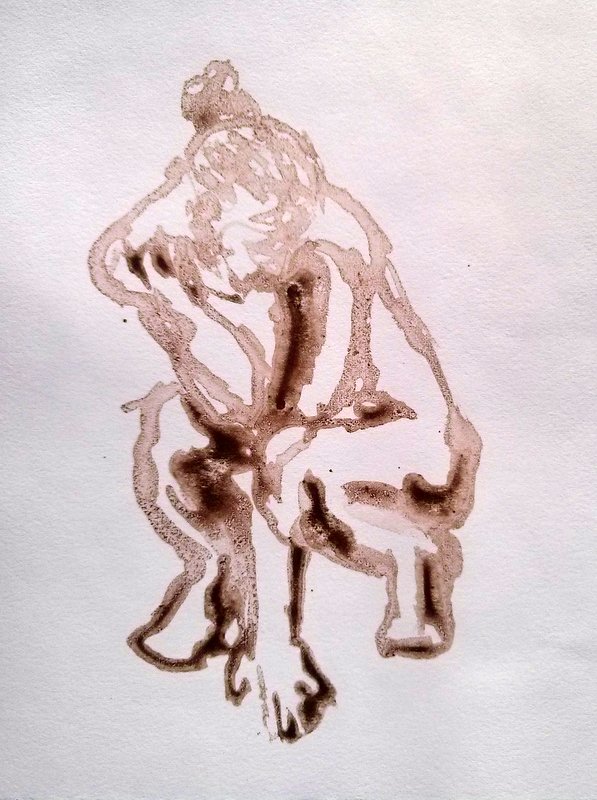
Walnut ink monotypes
Drawn from the model with a bamboo pen (in water-soluble walnut ink) on frosted mylar, then transferred onto soaked and blotted Johannot printmaking paper. Approx. 6" x 4"
Same as above, but the plate was heightened with gouache and printed onto toned Ingres drawing paper. The paper adds its own element of texture, especially in hand-pressing. Approx. 5" x 4"
20150923
monotype, cont.
There are myriad variables with each image--what medium to paint in, what paper to use... even differing degrees of dampness in that paper will determine how sharp the resolution is and how much color transfers. This is on kitakata paper. The background was printed first, the bird transferred from a second plate, then some details added with an ink brush.
This is a simple study of the outside surface of a pineapple, done in gouache and printed on drawing paper. Monotype is known as the "painterly print." Each impression is unique because most all the paint comes off with the first print, so they can't be duplicate-printed. The main advantage is that the process allows the introduction of textures which can't be made any other way.
Spoon and shadow, Neocolor II water-soluble crayon on frosted mylar, printed on Rives Lightweight printmaking paper. Heavyweight papers are great if you have a press. Working by hand, lighter-weight papers respond better to less pressure.
This is a simple study of the outside surface of a pineapple, done in gouache and printed on drawing paper. Monotype is known as the "painterly print." Each impression is unique because most all the paint comes off with the first print, so they can't be duplicate-printed. The main advantage is that the process allows the introduction of textures which can't be made any other way.
Spoon and shadow, Neocolor II water-soluble crayon on frosted mylar, printed on Rives Lightweight printmaking paper. Heavyweight papers are great if you have a press. Working by hand, lighter-weight papers respond better to less pressure.
20150920
monotypes
I've been playing with hand-pressed monotypes, a process I've loved since art school. It really changes things up. I don't have a press, so these are pulled by hand. The above plate was painted in watercolor, three layers, left to dry, then printed onto soaked and blotted Japanese kitakata paper. Image size 7" x 5"
This is a drawing in black Oilbar on the plate, printed onto toned drawing paper (which didn't like the punishment). This will become a chine colle'. Approx 4" X 6"
Mourning Doves. On the right, the image was drawn subtractively using black Oilbar. That image was the source for the plate on the right, painted in black gouache. Both are on Johannot, and reveal interesting differences. Textures and effects are possible in monotype that can't be achieved with any direct method. And pulling a print is like opening a present: you never know what you'll get.
Subscribe to:
Posts (Atom)