20120628

Outskirts of Albuquerque

Here are some paintings from the first week.  The air was hazy from nearby wildfires, which are dissipating now for the moment.  The colors in the landscape right around Albuquerque are surprisingly subtle, not what I expected.  For one thing, the Sandia Mountain range was given the Spanish name for "watermelon", commonly interpreted as referring to a reddish color.  Actually, the naming probably referred to what the Spaniards thought were watermelons growing nearby (in fact it was squash).  These mountains are very dull in local color, though the effect of sunlight through the hazy atmosphere gave them a soft beauty.


Rebonita  9 X 12"oil on canvas panel

It's been extremely hot, with strong afternoon winds.  The monsoon season will start soon, and things should cool off a bit.


Desert Highlands  9 X 12" o/cp

Both of the above scenes are right at the edge of residential neighborhoods which are expanding right up to the foot of the mountains.  The one below is from a forest service road at the entrance to a recreational area, at the northern end of the Sandia range.


Forest Road 333  9 X 12", oil on paper (BFK)

20120612

Honey Springs Road

12" X 9", oil on canvas panel.

East San Diego County has some truly beautiful scenery.  You'd never know it's just minutes from urban San Diego.

20120601

Anza Borrego


9 X 12, oil on canvas panel.  A recent trip to the Anza Borrego desert east of San Diego, on a very windy and beautiful day.  It was calm when I started this, but within half an hour the winds had increased to the point that it was difficult to hold my upper body still enough to make a decent brushstroke.  A panel any larger would have been a kite!

20120502

Ocotillo Late Day

11 X 14", oil on gessoed BFK
Sun getting low, colors changing.  This might be the prettiest time of day in the desert.


Not Currently Available (Inquire)

One more ocotillo plant, with the Carrizo Badlands in the background.  The ocotillos only leaf out and bloom very briefly, so it's pretty amazing to see them with all their red flowers.

20120429

Ocotillo Late Morning

Ocotillo, due east from San Diego, is a beautiful, wide-open space.

Looking north.  (not currently available--please inquire)

The scrub is still quite green from recent rains, and the ocotillo is still leafed out and blooming.

Looking east.  (not currently available--please inquire)

The subtlety of the colors in the desert and the beauty of the "big empty" (not to mention the hot, dry air) make this a magical place.

Looking south.  11 X 14", oil on gessoed BFK

We got there in the late morning.  As we got out of the car, we saw two desert iguanas--and one of them came right up to us!  It was the smaller of the two, so probably male or possibly a juvenile, although still well over a foot in length.  He was eating buds on the small weeds, unconcerned with us; then he kept getting closer:


Finally, he jumped right up on my husband...

Much later we learned that they are attracted to the yellow flowers of the creosote bushes, so that is probably what this guy had in mind.  Eventually he calmly meandered off, in search of more succulent buds to eat.

20120424

Palm Canyon


 9 X 12", o/cp.  This is Palm Canyon, one of the beautiful Indian Canyons south of Palm Springs.  It's very near where I painted last year.  Things are still very green over there from a lot of winter rain.

20120421

Morrow Canyon


 12 X 9", o/cp.  A stand of palms in Morrow Canyon, one of the three Indian Canyons near Palm Springs.

20120414

Strategies for Becoming an AIR

My artist talk (see previous post) met with a lot of enthusiasm and interest in how to become an Artist in Residence.  I thought it would make sense to post my suggestions here, so they are accessible to all who are interested.  As I get feedback from all of you, I'll update and correct this post so it will evolve to be even more helpful.

There are different considerations for applying to an existing AIR program, and proposing to create a new one.  First, here are some general strategies when applying to existing programs.

1.  Know the place and/or entity that you're applying to.  You'll know a lot more when you're done with your residency, but it's important to have some depth of knowledge beforehand (so that you know what you're getting into and are sure you want to go ahead with it). 

2.  Be sure to carefully read the description in the application materials--how THEY see the residency--and consider how your work fits the venue and the program.  Address every point very clearly when you write your statement of purpose, answer every question they've posed.  Think deeply about what you want to say with your artwork. 

3.  Submit your portfolio in exactly the format that they request.  For example, if they want a digital format, make sure to note the dimensions and medium that they want.  Don't send color slides if they want a CD, and vice versa. Always choose your strongest and most relevant work, and don't dilute it by unnecessarily increasing the quantity or diversity of the images.  More is not usually better, and may only show lack of focus.

4.  Make sure that you understand the terms of the residency up front.  What is included, in terms of housing and workspace?  What opportunities will you have to show your work, what percentage of sales do they keep, and are you obligated to donate a piece?  Do they want you to give talks, workshops and demos, or just work and not interact with visitors?  These are just the basics.

5.  Follow up.  Some places (like National Parks) don't always run like clockwork.  Things aren't on a hard and fast schedule, so if some time goes by without hearing back, check in with your contact person.  It's okay to take some initiative, within reason.


Now, on to my advice for you hardy trailblazing souls who want to propose (and help create) a new program where there is none.

1.  If you have a prospective host in mind, find any similar park, company, facility, museum or institute which already has an artist program of some kind, and (if it's successful) hold this up as an example to help show the potential for success.  This will help them to envision how such a program might work in their context, and can provide a framework for your mutual efforts in this new endeavor.
Conversely, if you don't have a place in mind yet, learning about existing programs elsewhere can help you envision a residency at a similar venue in your own community.  Start here.  The example I used in my talk can be found by clicking "Pacific" and scrolling down to Norcal Sanitary Landfill.  Yep, it's a dump in the Bay Area, and they have a very successful, longstanding AIR program.  Are there any landfills in your community that have AIR programs?  Maybe not, but maybe they should!  How about museums?  Know any in your area that have AIR's?  If not, maybe they should.  A listing like this can give you ideas and inspiration for programs elsewhere in the country that you can initiate locally, and can also show a prospective host that such a program can work very well.  Google "artist residencies" or similar keywords to get even more listings. 

2.  Think long and hard about why you want to do a residency for your chosen entity, so you can communicate that clearly.  Do your research, because having a depth of knowledge will show them that you know what you're getting into and have thought it through.  That will increase their faith in your judgment, and will indicate to them that you're a "self-starter" who isn't going to be high-maintenance. 

3.  Once you've picked a target and done your research, put together a proposal.  My first contact with Cabrillo was via email, with a brief description of what I had in mind, and four or five images of my work attached to the email.  I followed this up with a printed proposal, resume and portfolio sent by regular mail. You can try email if you have contact information for a person who might be interested.  In a National Park, that is the ranger in charge of  Interpretation and Education.  In a different setting, you might be looking for Public Relations, Community Outreach, Publicity, etc. Do they already have a Volunteer Program of some sort?  Perhaps a new AIR program could be part of that.

Include some images that represent your work.  Pick just a few of your very best and most relevant works. And, make those images immediately visible.  Not on a CD, not even a link that they have to click on.  If you make initial contact by email, attach or better yet embed some images of your work in the body of the email. When you follow up by regular mail, include printed color photocopies of your work.  If there's even one additional step required for them to see your work, like putting a CD into a computer or even opening a physical folder, it may never be seen.  Remember, they didn't ask for this submission.  You want to make it as easy as possible for them to see it instead of putting it in the "circular file".

4.  In your proposal, make your motivations clear.  Ideally, this will be along the lines of giving something back to a place that has meaning for you, enabling others to see the place as you do, community outreach on their behalf, etc.  Your motivation is not prestige, self-promotion or selling work.  Even if it really is. 

5.  It is important to keep a mindset of flexibility and willingness to adapt and improvise.  Especially if you're starting a program from scratch, let your prospective hosts know that you're prepared to do the work to establish the program, and you're not expecting monetary or personnel support (most places do not have the budget to provide materials or facilities for something like this).  By excusing them from financial obligation, you've taken away one of their reasons to say "no."  After all, you are going to gain a lot from this experience.  You'll grow as an artist, you'll have an impressive line on your resume, and you may very well sell a lot of work.  Your host will benefit from your artistic representation (there is just no better form of  PR), and if they take a percentage of your sales, they stand to benefit financially too.  It's really a win-win.

6. Don't give up if there is initial resistance.  If there is even one person who sees this as a good idea and believes that it can work, perhaps all it will take is some gentle persuasion to push it through. In my case, it took several months to get approval; but because there was one ranger who saw the value and potential for a program like this, and because he was relentless, it became a reality.


If anyone has thoughts or feedback about this, email me and I'll update this post--so keep checking back!

20120404

My upcoming Artist Talk

If you happen to be in the San Diego area, come on by.  Many thanks to Lesley Anderson for putting together this great flyer.  See next post (above) for my suggestions to all future AIR's!

20120226

Last Lighthouse Painting

A couple weekends ago, my show was still up at Cabrillo and I painted there on site with the local Meetup group of plein air painters, looking forward to interacting with Park visitors and hopefully sending some of them to the Visitors Center to view the exhibit.  Normally I don't paint that well when I'm mostly devoting my energy to conversing with the visitors, but this one didn't turn out too badly.  It is probably the last lighthouse painting I'm going to do for quite some time.


12" X 9", o/cp. Sold.

20120202

Dahlias revisited


14" X 11", oil on linen panel.  Awarded Honorable Mention, Art In Bloom, San Diego 2011

20120128

Nexus


20" X 24", oil/stretched canvas. Sold, private collection.

This painting is the centerpiece of the Cabrillo Series.  This is how it looks there mosts days, overcast with a cool breeze off the ocean.  Included are most of the elements which not only identify this place, they define it.  

The Old Lighthouse still stands watch over the Point.  The radar towers are active and maintained by the US Navy, who is responsible for establishing and helping maintain the Point Loma Ecological Preserve.  Coastal scrub and Shaw’s Agave, endangered native plants, flourish here.  The viewing stations overlooking the ocean at right offer information and an ideal vantage point to those who watch migrating Pacific Grey Whales passing nearby between December and March.  The beautiful crumbling sandstone bluffs remind us that all of this is ephemeral.  We can feel the importance of protecting and supporting this place here and now, as it continues to protect and enrich our lives.

The reception for the show is tomorrow, so with this post I conclude the Cabrillo series.  You can see all 26 paintings in the show here and all work done on the subject of Cabrillo here.

20120125

Old Lighthouse with Torrey Pines


9 X 12", oil/canvas panel

This started as a plein air painting at a very popular spot near the Lighthouse, with scores of visitors constantly walking by and stopping to chat.  I absolutely love interacting with the visitors there, they're from all over the world and are always so appreciative and complimentary.  But the painting usually suffers a lot due to my inattention and lack of focus, so this panel was headed for the bin when I got home.  At first I tried to salvage it, and only made it worse.  Then I completely changed it, moving the lighthouse to the left, changing the vantage point, and including much more of the trees.  Sometimes you have to completely let go before things will begin to come around.  The only part left from the original painting is the small dark area at the lower right, but now I'm really happy with it.  It would be interesting to x-ray this one.

20120123

Bayside Trail Revisited


12" X 16", oil/canvas panel

One of my favorite plein air studies in this Cabrillo series was the Bayside Trail 6" X 8", painted on site.  Studio paintings done from studies have their own unique identity.  A remembered impression, rather than an observed one.

About the Bayside Trail:  This former Army road now provides a wonderful 2-mile hike for visitors, with information plaques describing the vegetation, birds, and other wildlife they might see there.  This vantage point is at the end of the trail, looking back toward the starting point (at upper right, near the radar tower and Old Lighthouse).  Behind me was Ballast Point, where Cabrillo made landfall in 1542, which is now part of the Navy's SPAWAR division.

20120122

Spirit of Cabrillo


12 X 16", oil/canvas panel.

Visitors enjoy a clear view south toward Mexico, as a military transport plane (probably a C-130) comes in for a landing at North Island Naval Air Station.  North Island is a stone’s throw from Ballast Point, probably the site where Juan Rodríguez Cabrillo made landfall in 1542.  The commemorative statue of Cabrillo was donated by the Portuguese government (Cabrillo was Portuguese).  The original statue, created in 1939, eroded over time and was replaced in 1988 with this exact replica, made in Portugal.

20120121

Egret Surveying Zone 3


12" X 16", oil/canvas panel

This is from a photo taken during a visit to my friends at the Coast Guard outpost, not far from the New Lighthouse.  Shorebirds are a beautiful presence at the Monument, and their numbers are closely monitored by Rangers and volunteers.  A count is taken by hand every time there is a low tide (exposing the tidepools) and a tally is kept of which birds, and how many, visit each of the three zones of tidepools.   This Great Egret is unconcerned with the solar-powered monitoring station right beside him.  He was a bit concerned with us, though, so we took a photo and quietly moved away so as not to disturb him.

20120120

Darkling


20" X 24", oil/stretched canvas. Sold

Today I  hung the last three paintings in the Cabrillo series.  There are 26 paintings at the Monument Visitors Center, and one in the show at L Street Fine Art (shown second from right, top row, on their website).  Now I can finally get the blog caught up with all the work I haven't posted here yet.  

This is a Darkling beetle, an abundant species of the genus Eleodes which can be seen scurrying all over the area here.  They are also known as Clown Beetles or Stinkbugs, and are unique among our local beetle species for their daytime activity.  They move about fearlessly because they have a pretty effective defense mechanism:  when alarmed, they will stop and raise their rear end and spray an offensive substance to foil their pursuers.  They're large (about an inch and a half long), harmless, and make a beautiful, satiny black color note against warm hues of the sandstone rock and sand.  

I love insects, as well as reptiles, amphibians, and birds.  They're beautiful things.


20120115

The Show is Up!

We hung the show at Cabrillo National Monument yesterday, and in the next couple days I'll get caught up on the most recent work that I haven't posted here yet.

This is the flyer (created by Ranger Tavio) to promote the show:


And here are some shots of the gallery and the installation process:


Ranger Tavio (right) and I, hanging a painting.  Below: the gallery, looking left and right.  One could not ask for a more beautiful setting.  It really adds dimension to the work, seeing the actual landscape where many of the paintings were created.


This is the information table, where there is now an exhibition catalog, business cards, my statement and CV.   That painting (yet to be posted here) is 20 X 24, and is really the centerpiece of the show.  It sums up my intention in this body of work.

If you would like to see all 26 works in the exhibition with my descriptions of each painting, you can see them on my website at this link.

A special shout-out to my sainted husband, who was instrumental in the success of this 4-hour installation process and who also took these pictures.

More soon.

20120110

Lighthouse from the Bluffs

This is the back of the Lighthouse, viewed from the bluffs, done during the last paint-out with the Meetup group. 

12" X 9", o/cp. (Sold, private collection)

The intermittent fog and hazy sun made for an interesting atmosphere, but the challenge was to render that white building against a cool bright sky in weak sunlight, and to push it back so that the bluffs would get the attention.   This is a study for a larger work in progress, so I wrestled with this a bit.

Painting for a residency feels a bit like a combination of commissioned work (and it is, in a way, since one painting will be donated to the Monument's permanent collection) and painting to please a certain audience (the park visitors).  I have my own concept, which I've talked about here, and have mainly expressed it with subjects that interest me.  The response has been overwhelmingly positive, though admittedly everyone still wants to see more of the lighthouse.  And that's okay.

20120107

Old Lighthouse


11 X 14", o/linen panel.  The endangered coastal scrub on the rocky hillside below the iconic old lighthouse is wild and beautiful.  Radar towers at left belong to the Navy, which has been instrumental in establishing and co-managing the Point Loma Ecological Reserve.  The Torrey pines near the building were planted in the 1930's; we can't be sure if there were ever Torrey pines naturally occurring here.  They were very widespread in this region millions of years ago, but currently there are only two remaining native populations.  One is Torrey Pines State Reserve, a few miles up the coast, and the other is on Santa Rosa Island near Los Angeles.

20120105

Cabrillo Show and new work

I've been working feverishly to finish some larger works for the upcoming solo show at Cabrillo Monument, and will be posting those very soon.  The show runs January 14-31.

Here are updated versions of a couple small paintings.

 End of Point, hazy morning color.  8" X 6", o/cp. Sold, private collection.


Winding Tidepool Path.  6" X 8", o/cp.


20111225

Happy New Year!

Sincere greetings of the season, and happy Solstice--days are getting longer, at last!  Many thanks to everyone who has taken the time to look at my work, I'm very grateful to all of you who stop by.


 Cherry Pie, 6" X 8", oil on canvas panel

And the paintings below have been selected for a group show at a terrific gallery in downtown San Diego, L Street Fine Art, with a reception the evening of February 4, 2012.  The theme of the show is abstraction.  Here they are:

 June Gloom and Jacarandas, 6" X 6" oil on Ampersand Gessobord panel


La Playa Cove Morning, 8" X 6" oil on canvas panel

Dudleya (Live Forever), 10" X 8" oil on panel

20111129

A Nice Surprise

I'm the featured artist this week on Judson's Plein Air Journal!  I had no idea that was in the works, just got a note from Sarah Judson after the post was up!   She chose one of my favorite Cabrillo paintings to feature, Searchlight Shelter.   Judson's is a long-time favorite source of plein air supplies, they've got everything--including the Guerrilla Painter line of pochade boxes, like my little one pictured on my bike -->.

Also this week, Katherine Tyrrell kindly included my autumn DC painting post on her terrific Art of the Landscape blog.  Katherine's blogs are always interesting and informative.


20111113

Adventures in DC

Constitution at Pennsylvania Avenue, 6" X 8", oil/canvas panel

The fall colors were still mostly on the trees, but leaves were falling fast and some trees were already quite bare.

National Mall from the steps of the National Gallery, 8" X 6", o/cp

The National Gallery has a fabulous Sculpture Garden, and that was a great place to sit and paint.

Landscape with Ellsworth Kelly, 8" X 6", o/cp

8th and G at Sunset, 8" X 6", o/cp

20111104

Untouched


20" X 24", oil on stretched canvas.  There are tidepools and shoreline below the "new" lighthouse which are not accessible to the general public.  The effect of this was obvious when I saw these beautiful stones and shells laying there undisturbed. Two of the three "zones" of tidepools at the monument are open to the public, and even though there is a strict rule against lifting or disturbing anything there, those areas are pretty well picked clean.  I loved having the chance to see these natural ocean-polished stones, shells, and even coral.

Because this is a larger painting, the resolution of my camera doesn't pick up the detail too well--so here are some detail shots.


Thanks again to the very gracious Coast Guard family who granted me the opportunity to see and paint these beautiful scenes and objects by the lower Lighthouse.

20111029

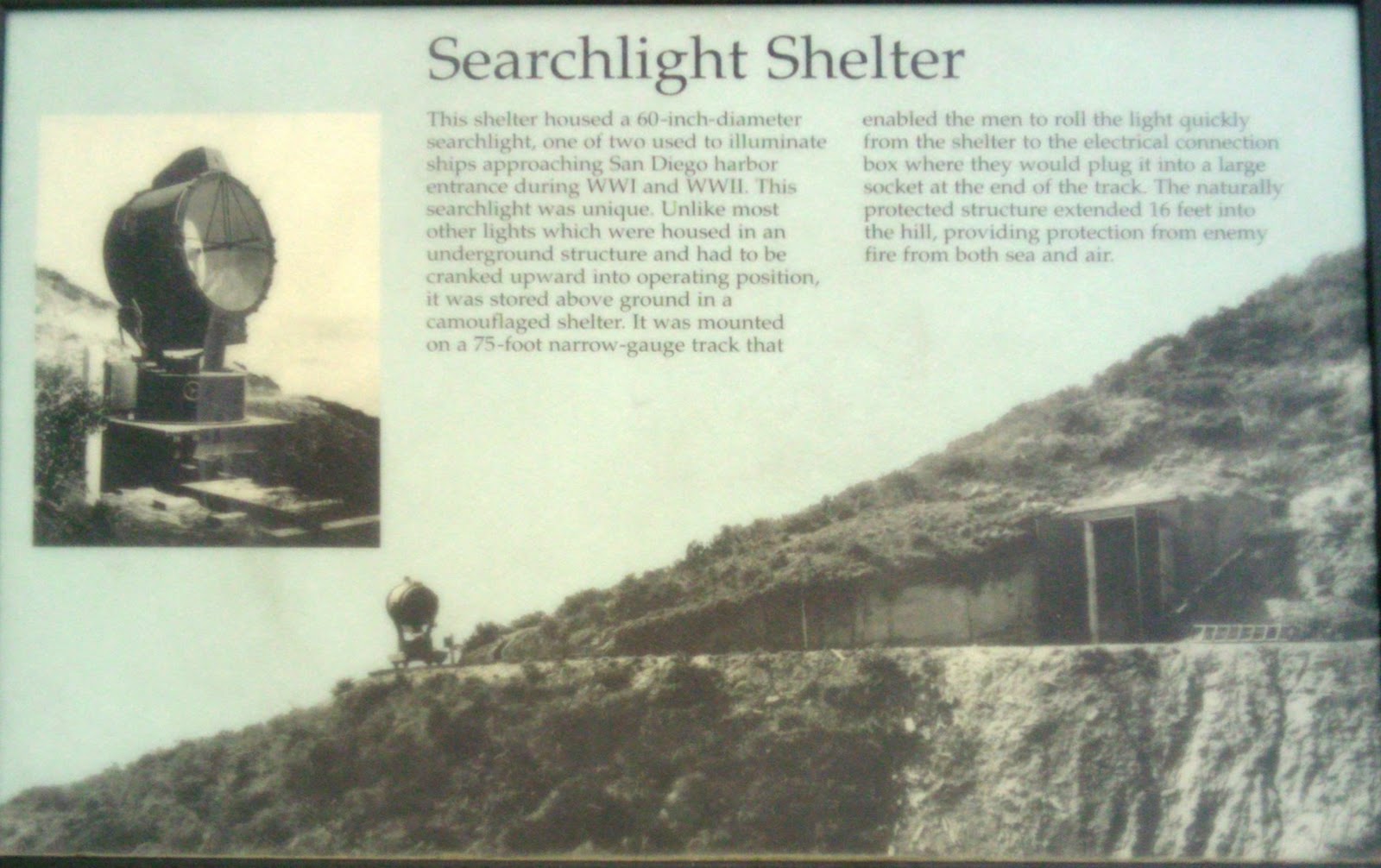
Searchlight Shelter


10" X 8", oil on panel.  Sold, private collection.

Along the Bayside Trail at Cabrillo Monument, there is this interesting large metal enclosure built deep into the hillside.  It's the Searchlight Shelter; more about that further down. 


To show a step in the process, here's how I started this painting on site, quickly noting some color and value relationships and placing landmarks in a composition that I was happy with.  Then, using a photo reference at home, I corrected drawing errors and fleshed out the color.  Now you're probably wondering, what the heck is this thing?


Click on the image to see a readable enlargement.  The searchlight was on rails, of which there are remnants visible coming out the front of the enclosure.  The rest of the track is gone, the cement retaining wall has eroded away/been buried by sandstone erosion, but the shelter remains and its former path is an integral part of the Bayside Trail.  In addition, the area has become a case study in the effects of habitat disruption, to help us learn more about the importance of preservation.

20111023

Climb to the New Lighthouse


Looking up at the "new" lighthouse (built in 1891) from the shore below.  The cliff is not too high, but steep enough such that the only way to climb it is with the help of that rope.   8" X 6", oil/canvas panel.

Ever wonder what a foghorn looks like?


Those openings are the "speakers", and the concrete slab probably helps project and disperse the sound.  And it is LOUD, audible for miles.

The lighthouse and the foghorn do all they can to warn mariners away from the rocks below, but every so often, there's someone who disregards the warnings.  That's when this happens:


A fiberglass carcass on the rip rap.